

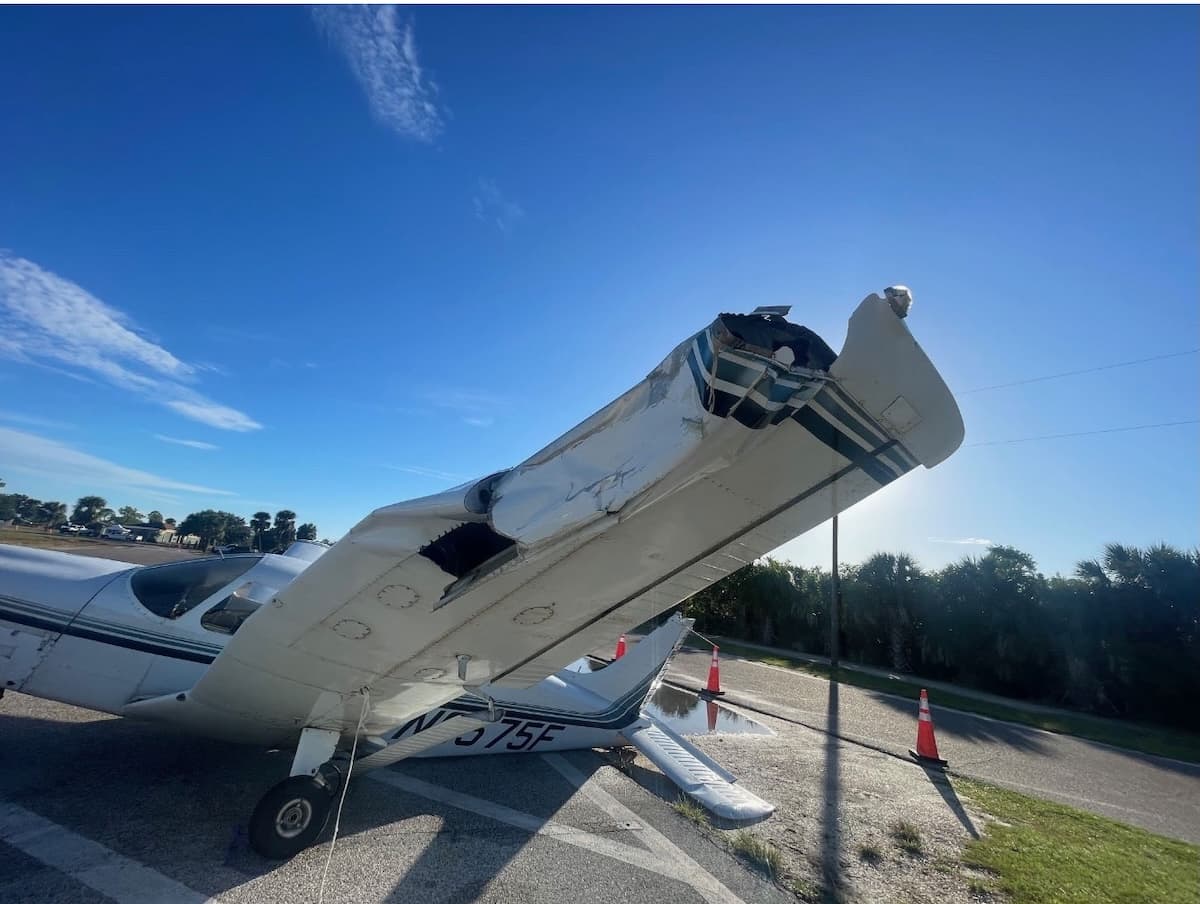
The student pilot told investigators that the plan for the day was for he and his flight instructor to fly a round-trip cross-country flight from Albert Whitted Airport (KSPG) in St. Petersburg, Florida, to Arcadia Municipal Airport (X06) in Arcadia, Florida, a straight-line distance of 54.2 nm. After returning with his flight instructor to KSPG, the student pilot would then fly the same cross-country flight solo.
The student pilot arrived at the airport and performed a preflight inspection of the Piper PA-28-181. The flight instructor reported that when he arrived at the airport, the student had performed a preflight inspection of the airplane, verified full fuel, and had calculated how much fuel was needed to complete the flight.
The flight departed KSPG about 0830 and the student pilot reported that as the flight crossed Tampa Bay, they noticed cloud cover becoming denser so they made the decision to change the destination from X06 to Sebring Regional Airport (KSEF) in Sebring, Florida, a straight-line distance of 70.9 nm, which added 16.7 nm from KSPG.
They landed at KSEF and returned to KSPG, where the student pilot dropped off his flight instructor about 1000. About 1007, he departed on his solo flight for KSEF, where he landed about 1058. He departed for KSPG at 1106.
About 9 nm from KSPG and at an altitude of about 800 feet mean sea level (msl), the student pilot reported that “the engine stalled, came back, and stalled again.” The airplane descended and hit the water, resulting in substantial damage to the left wing.
The student pilot reported that there were no pre-accident mechanical malfunctions or failures with the airplane that would have precluded normal operation. A post-accident examination of the airframe and engine did not reveal any pre-accident mechanical malfunctions or failures with the airplane.
Fueling records showed that the airplane received 24.9 gallons of fuel the day before the accident flight, and the student pilot reported that the fuel was full before the first leg of the day. He also reported that he did not refuel the airplane at any point.
The airplane’s Pilot’s Operating Handbook (POH) states that the airplane has a total fuel capacity of 50 gallons, of which 48 are usable.
The student pilot reported that due to the altitude of the flights being under 3,000 feet msl, he never leaned the mixture.
He also reported that he had switched between fuel tanks throughout the flights when prompted by the avionics and that this prompt was on a timer set for 30 minutes.
Fuel calculations performed using data recovered from the onboard avionics, the POH, and fuel consumption from the engine manufacturer found that, not including time spent with the engine running on the ground, one tank would have used about 22.4 gallons of fuel and the other about 15.6 gallons of fuel if the fuel selector was switched from one tank to the other every 30 minutes.
The student pilot reported that once the engine lost power, he did “ABC: Airspeed, best place to land, and checklist, but I did not have enough time for checklist.”
A review of the POH showed that the first item on the “Engine Power Loss In Flight” checklist is “Fuel Selector…switch to tank containing fuel.”
Probable Cause: A total loss of engine power in flight due to fuel starvation. Contributing to the accident was the inadequate preflight fuel planning by the student pilot and flight instructor, and the improper inflight fuel management by the student pilot.
To download the final report. Click here. This will trigger a PDF download to your device.
This October 2024 accident report is provided by the National Transportation Safety Board. Published as an educational tool, it is intended to help pilots learn from the misfortunes of others.
First thing that caught my eye was the timeline of dropping off the instructor at 10 and departing at 1007 leaves little time for the CFI to complete the endorsement for 61.93(c)(3). This would be required since the cross country destination changed from X06 to KSEF. That being the case, the cross country would’ve been illegal since the student was not endorsed to land at SEF.
BUT, I realize that is not the point of the article. There’s plenty of other evidence that the planning was substandard, not to mention the instruction.
Glide Speed, Landing Spot, Go through the fuel system (tank, pump, mixture) then checklist.
280 miles round trip doesnt seem too far for a fuel fuel Cherokee…..
Glad the young man wasn’t hurt.
The weather was already deteriorating sufficiently early in (prior to?) the first dual flight for them to change their flight-planned destination.
There’s no indication that they discussed the weather, or any associated contingencies, before launching the student back into it for his solo flight.
The student ran out of gas 9 miles from his final destination …at 800’ over Tampa Bay.
Why was he already down at 800‘ that far from the runway? He was ‘scud running’.
Some bad decisions by both individuals; but an “epic” failure on the CFI’s part.