

A recent survey found that parts and supply chain pressure is the biggest challenge facing general aviation maintenance today.
It’s hardly a surprise, say officials with TBX, a company that provides software to general aviation maintenance shops to track workflow, regulatory compliance, and more.
Following the release of its annual survey earlier this year, the company did a deep dive into that parts supply pressure with its new survey, “The Great Parts Squeeze.”
“Between OEM consolidation, discontinued production runs, and a maintenance workforce stretched thinner every year, the simple act of sourcing a part has become one of the most persistent operational headaches for shops across the industry,” TBX officials said.
While mechanics and maintenance shops are often the first to experience the consequences of long lead times, discontinued components, pricing pressure, and limited supplier options, their perspective is rarely captured in a comprehensive, industry-wide way. The company’s new 2026 General Aviation Parts Survey was built to change that.
“By gathering direct feedback from the professionals who source, install, and certify aircraft parts every day, we set out to identify the industry’s biggest pain points, emerging trends, and opportunities for improvement,” TBX officials said.
Company officials add they hope the results will give aircraft owners, manufacturers, distributors, PMA suppliers, regulators, and trade associations “a clearer, evidence-based view of where to focus — so we can strengthen the general aviation maintenance ecosystem for everyone.”
Time is the #1 pressure, not price.
“Time has become general aviation’s most valuable currency,” TBX officials said. “Talk to any maintainer or owner in GA today and you’ll hear about it: Time looking up part numbers, time searching for parts, time spent working with a plane owner on available options, time haggling. All of it adds up, and much of it drags on shop utilization.”
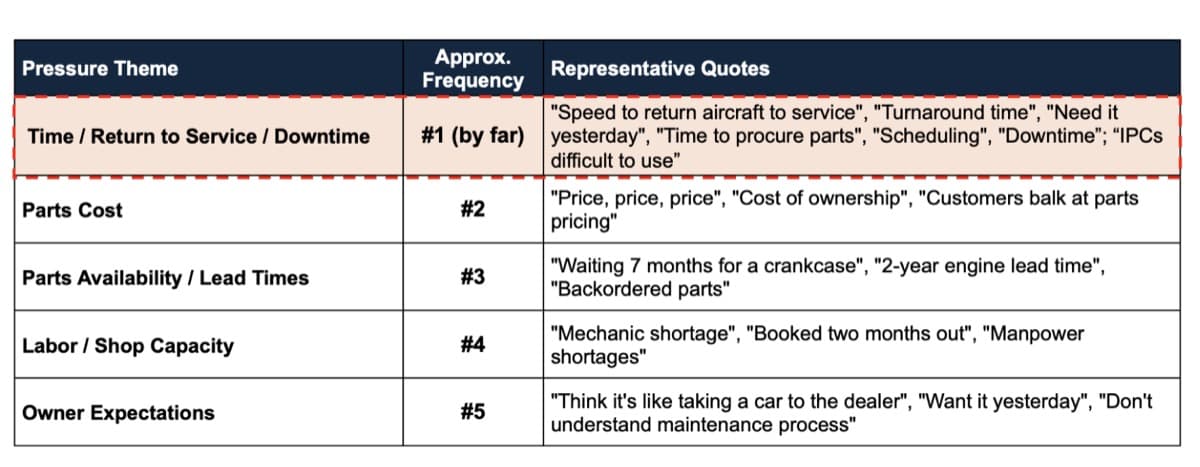
The second demand on time is scheduling, made worse by the difficulty of finding and retaining qualified A&Ps.
Time spent managing customer expectations rounds out the picture: Shops report owners increasingly expect legacy-aircraft pricing on a modern supply chain.
“We see the most pressure coming from customers with older aircraft, expecting the same bill they got five or 10 years ago,” one shop owner said.
There is a high level of dissatisfaction surrounding pricing and lead times.
Nearly three-quarters of respondents (72%) said they were dissatisfied with pricing, and nearly two-thirds (59%) said the same about lead times. After several years of consolidation, the industry has seen price increases of 100% to 400%, often with little corresponding improvement in support.
Unless rising prices are met with real gains in supportability, there’s a real risk that operators are forced to cut corners — undermining safety gains the industry has made over the last 20 years, TBX officials noted.
Big shops feel the most pain.
Conventional wisdom suggests small GA shops — without dedicated parts staff or buying power, working on legacy aircraft — should see the most delays. The data says otherwise: The largest shops, with dedicated parts personnel and accounts at every major distributor, report the most delays. That’s because they see the most aircraft, order the most parts, and deal with the most delays.
Many of these larger shops service business jets — relatively newer aircraft that often lack PMA alternatives.
OEMs, meanwhile, are struggling to manage complex supply chains across dozens of models, and many lack the data to see what operators are actually experiencing, while focusing resources on new-aircraft sales over aftermarket support.
Bigger shops prioritize availability over price.
For flight schools, charter operations, and Part 135 operators, downtime is lost revenue. Shopping around matters less than getting a part now — so larger, higher-volume shops weigh availability well above price.
Smaller shops serving single-engine piston owners flying for pleasure see a more even trade-off: with owners increasingly price-sensitive, shops have to show they’ve shopped around before charging for parts and labor.
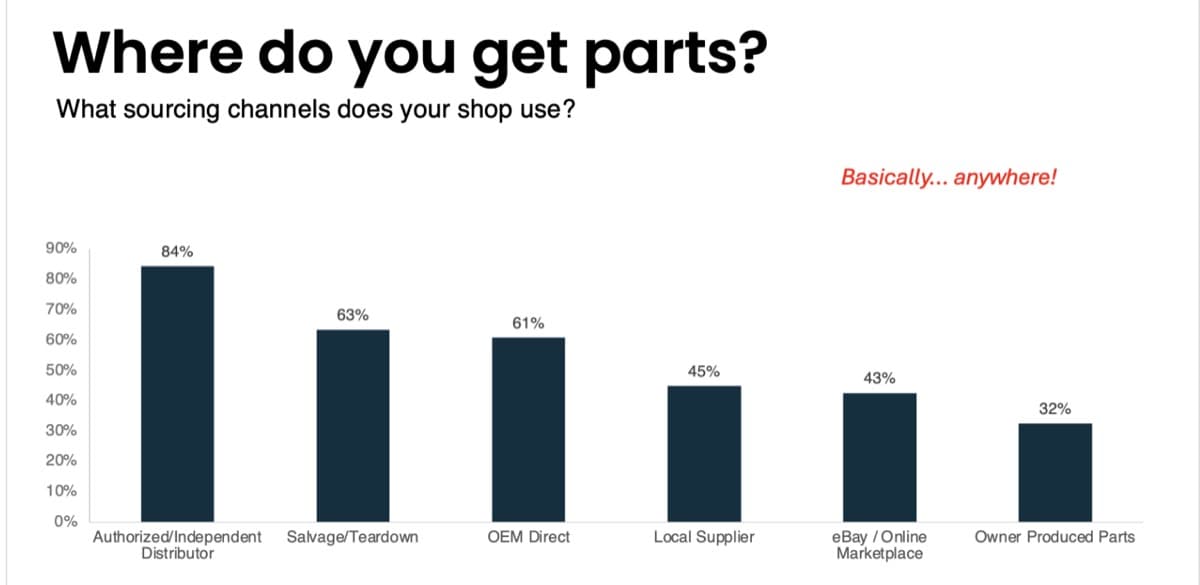
Small shops use multiple sources for parts.
Smaller shops lean on a mix of PMA parts, salvage, and owner-produced parts — driven by owner price sensitivity and the sustainment challenges of legacy aircraft.
Many OEM Tier 1 and 2 suppliers for older models no longer exist, and parts diagrams often don’t exist in modern, searchable formats.
“We can normally find the parts we need, but it takes multiple sources and looking around,” one respondent said.
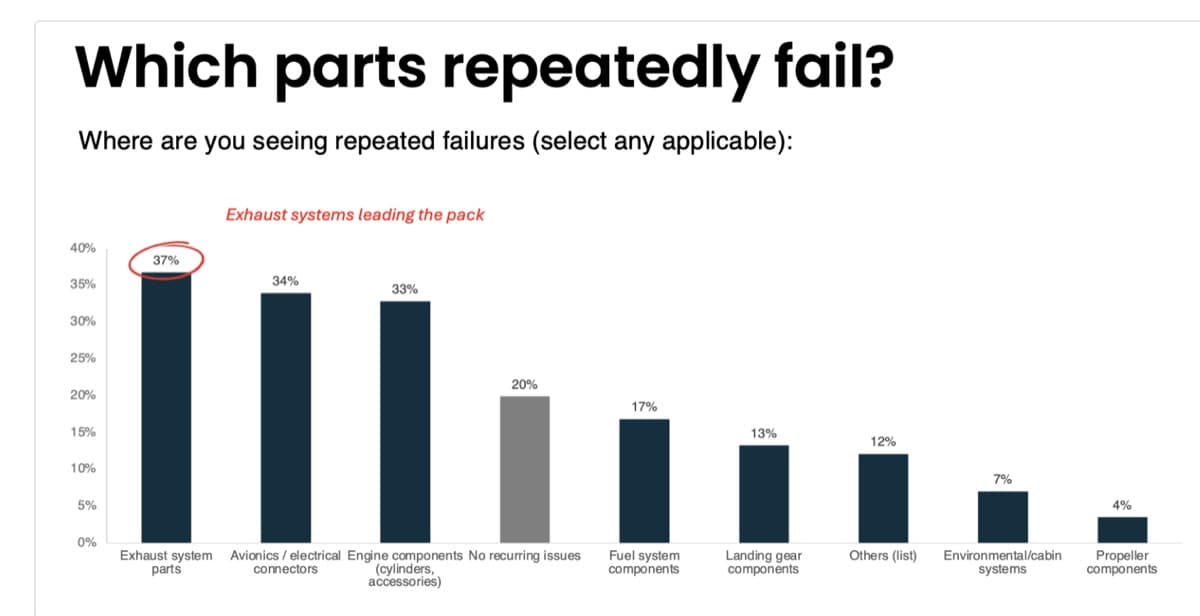
Exhaust, avionics, and engine components fail most often.
All three are familiar pain points in GA: Exhaust systems have seen recurring issues, and avionics/electrical components remain complex, especially on legacy aircraft.
“When the price of an overhauled engine is more than the aircraft it’s going into, the entry-level aircraft will be scrapped — meaning fewer will be flying,” a survey respondent declared.
Perceptions of PMAs are largely positive.
While PMA vs. OEM is a constant topic of debate at air shows and trade events, the data is clear: The experts responding to the survey say PMA parts exceed OEM parts on availability and cost, with 92% seeing PMA parts as matching or exceeding OEM on quality.
If perception is this favorable, why isn’t everyone buying PMA? The simplest answer: PMA alternatives don’t exist for every part — especially in the turbine world.
And it’s only going to get worse.
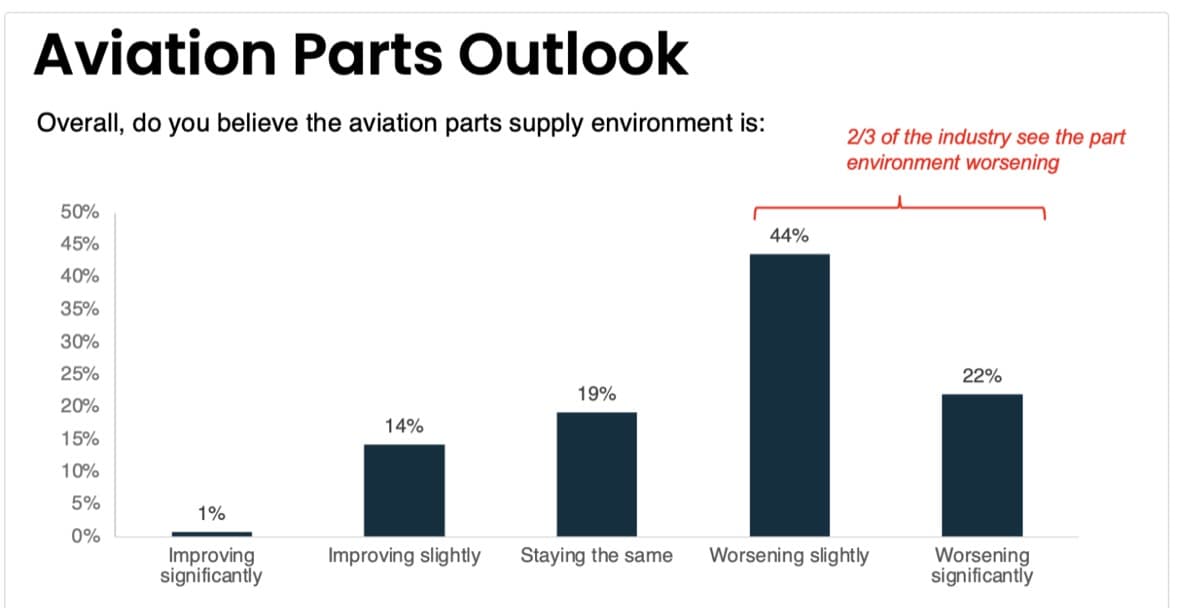
Two-thirds see the supply chain worsening. The survey found that 44% of respondents expect the parts environment to worsen slightly, while 22% see it worsening significantly. Just 15% see it improving. Rising prices, limited availability, thin OEM supportability, and quality concerns were all cited as drivers.
“It’s hard to find parts for legacy aircraft when the manufacturer refuses to provide support and refuses to allow anyone else to repair a broken part,” a survey respondent shared.
You can read the survey’s full results at Airworthy.com.
Lets see if I have this correct? Prices are high, supply is low.
First: Inflation, yep more than was ever shown has happened since COVID. So what was $100 in 2019 is now $132 if you go by if you go by US Govt Core Inflation Rate. Of course aviation seems to have been hit much worse than this Core Inflation rate. I would suggest what was $100 in 2019 is now more like $180. No, I don’t have anything other than my experiences buying parts and paying A&P and Avionics shops. (One example I had was a factory remanufactured engine was $44.7K in 2019 and now is $74.2K)
Second: Fleet size. The fleet continues to get smaller and smaller. Some of those planes have usable parts sold to planes still flying. While the market shrinks, it is hard for any company (or person) to invest in making new PMA part or STC if they know they won’t sell many of them. Based on the amount of FAA rules to read, understand and follow; I would think most would rather invest in making part for something else like golf carts or cars even.
So with all this, we can whine all we want as owners, but nothing is going to change unless we can convince the FAA to radically change the rules for our legacy GA airplanes.
Absolute disaster! When will the capitalism and the laws of supply and demand kick in to this industry? Demand is there and not being fulfilled. Consumers need the product, have the resources to pay for it and can’t get it! There is a fortune to be made here and no one is going after it!!!
Get rid of hedge fund groups buying up the parts manufacturers and produce liability lawyers would be a good start.
Cowl stiffener for a C-150 . . . 3/4″ by 3/4″ by 1/16″ angle, 2024T3, bent into a gentle curve. Less than 3 feet long, total. $1,200 from Cessna, $750 from NOS source (they have six, and since these don’t wear out, they’ll have them for a LONG time), material from A/C Spruce is under $20. Owner-made parts, anyone? And yes, I have an A&P and IA to approve it.
My pre-COVID-flation $35 ELT battery is now over $150, and that’s just one example. This is simply gouging.
Especially when you take it apart and figure out it’s like 4 D cells in a fancy package!
But even regular AA bats have gone double plus $ since then…
It’s actually 8 alkaline D-cells, we can buy for $15…..$100+ for the stc/ pma.!!
I was once standing in line at grocery store check out. In front of me was a very elderly man with 2 peaches and 1 quart of milk. The you lady ran up the items and said: “That is $5″ The old man was aghast and said ” FIVE DOLLARS !!!??? You have to be kidding me!!!!” “I’m not going to pay that!!!!” And proceeded to huff out of the store. The clerk rolled her eyes and started to ring up my order. Happened about 30 years ago.