

The pilot performed a preflight inspection on the Piper PA-28R-200 with no anomalies noted. The airplane departed from the Crystal Airport (KMIC) in Crystal, Minnesota, for a local flight.
As he returned to KMIC, he completed the before-landing checklist and was cleared to land by air traffic control. During the landing flare, the plane encountered a gust of wind, climbed about 3 feet, and landed on the runway centerline. The pilot described the landing as firm, but not hard. The airplane was refueled and returned to the hangar with no issues.
The next day, the pilot’s son flew the airplane. He performed a preflight inspection with no anomalies noted. After takeoff, he retracted the landing gear and noticed that the “gear in transit” light stayed illuminated. He extended the landing gear, and all three green landing gear lights were illuminated. He landed back at KMIC and taxied to the hangar with no issues.
The following day, the pilot’s son flew the airplane from KMIC to the Rochester International Airport (KRST) in Rochester, Minnesota, to have a mechanic inspect it. He flew the airplane from KMIC to KRST with the landing gear extended the whole flight and landed and taxied at KRST without incident.
A post-flight inspection by the mechanic revealed a fractured engine mount at the nose gear attachment point.
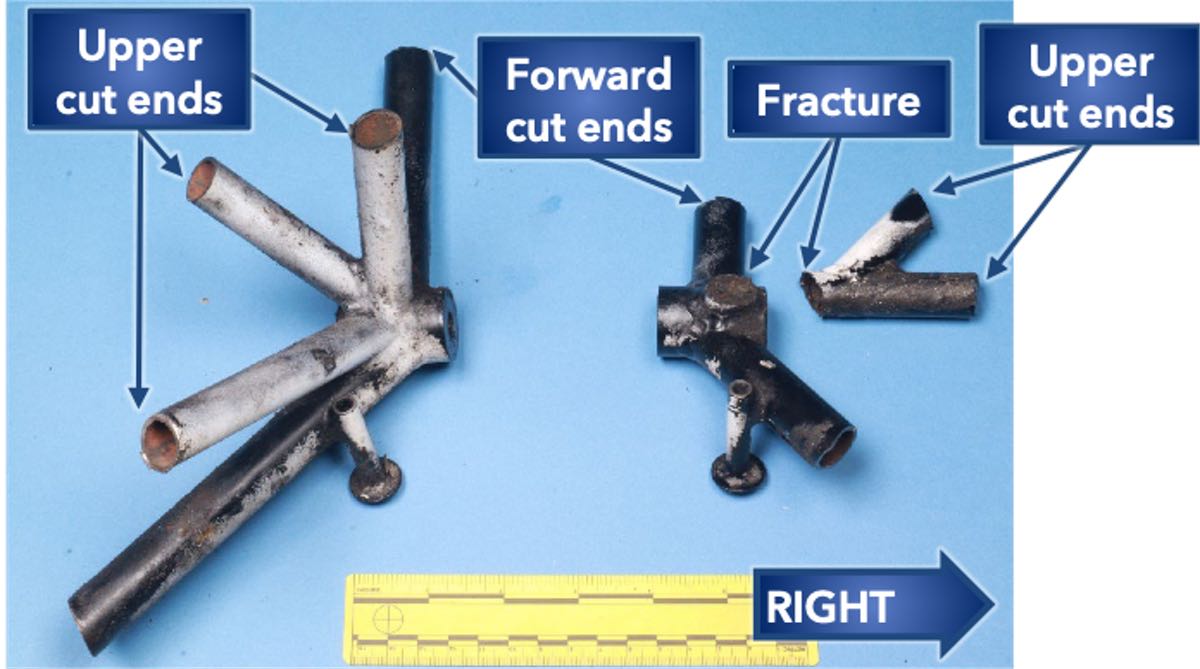
A post-accident examination of the engine mount revealed that the fracture surface showed substantial damage from oxidation and post-fracture contact. Greasy deposits were observed covering the black painted surfaces over most of the fractured tube’s exterior surface. On the interior of the fractured tube, an accumulation of greasy, mostly black deposits of corrosion products and other debris was observed.
Areas with relatively flat features in planes perpendicular to the tube axis were observed in several locations, mostly on the left half of the fracture. Additional features, including radial lines and ratchet marks, were also observed in these areas emanating from the interior edge of the fracture. These fracture features were consistent with fatigue initiating from corrosion pits at the interior surface of the tube. Each fatigue region had multiple origins.
The fatigue regions appeared to extend through the wall thickness on the aft left and forward left portions of the fracture.
At the forward right side of the fracture, the fatigue region extended part way through the thickness. An area on the left side of the fracture was smeared from post-fracture damage, so the fracture mechanism was undetermined in that area. The remainder of the fracture surface outside of the fatigue boundary and to the right of the fatigue regions had rough features on slant angles consistent with ductile overstress fracture.
At the time of the accident, the airframe, which was manufactured in 1974, had accumulated 3,711 hours. The most recent annual inspection on the airframe was completed on Nov. 8, 2023.
Probable Cause: The failure of the engine mount under normal operating loads due to the fracture of a vertical tube that was weakened by corrosion and fatigue of the internal surfaces.
To download the final report. Click here. This will trigger a PDF download to your device.
This September 2024 accident report is provided by the National Transportation Safety Board. Published as an educational tool, it is intended to help pilots learn from the misfortunes of others.
There does not appear to be any accident asociated with this structural failure incident. In military format, this might be classified as a HAP = High Accident Potential.
This article says “at the time of the accident…..the aircraft had accumulated 3711 hours”. But it also states that the last landing and taxi was without incident. So when was this accident?
The accident happened on Sept. 4, 2024.