


It is no secret that the drop-out rate for student pilots is astoundingly high. Embarrassingly so. In some circles it has been estimated to be as high as 80%.
In any other industry that would be a crippling deficiency. In aviation the failure rate has been consistent enough that one might come to the conclusion it is simply accepted as an unalterable fact.
Not so fast.
There are a variety of reasons student pilots give up. Money is certainly a significant variable, as is the number of quality training options available to them, the convenience of proximity to those outlets, and the viability of the aircraft we fly. But there is another factor that is rarely considered that just might play a role in this dilemma.
The language of aviation is mysterious, confusing, and hard to learn.
Here’s an example. An aspiring pilot might overhear a conversation at the FBO that sounds like this: “I was high and fast as I was turning base. So I pulled the manifold pressure back to 19 inches, pushed the prop to flat pitch, dropped 20° of flap, and kicked in an aggressive slip. By the time I turned Final I was dead on at 1.3 times VSO with two red and two green on the VASI.”
To a pilot that makes complete sense. To a non-pilot it’s absolute gibberish. And that’s a problem.
Enter Daniel Bezden. A South African native who has lived in Texas for the past 25 years, Bezden has brought his creativity and a unique skill set to bear in solving the incomprehensibility problem.

“I started flight training when I was 16,” Bezden explains. “Pursuing flight training was something I wanted to do from a very young age.”
And so he did, earning his pilot certificate by the age of 17. Quite an accomplishment for anyone, anywhere.
“In South Africa I couldn’t drive until I was 18,” Bezden recalls. “My parents had to drive me to the airport when I had a lesson.”
Like so many of us, life got in the way as he married, had children, and began building a career. Aviation fell to the wayside for a time. By his early 50s he was back in the cockpit and has remained there for more than a decade. All the while, his imagination was working overtime to resolve the issue he sees as pressing and detrimental to flight students.
“There is a reason people drop out and lose interest,” Bezden says. “It’s the words. It’s as simple as that.”
Bezden’s solution involved enormous amounts of research, planning, execution, and revisions. The product he’s developed is Keynomen (Key-no-men), a language learning app that goes far deeper than merely listing terms and defining them.
“One of the things you want to avoid when you’re writing a dictionary is using technical language in the definitions,” he says. “You get into these word chains. Students find themselves digging a hole over language.”
Bezden’s sincerity in his quest is apparent as he speaks.
Any casual flier who has tried to understand with specificity what “adiabatic lapse rate,” “heavy,” or “occluded front” really mean is familiar with the confusion.
Where Keynomen differs from simple glossaries and dictionary definitions is in its presentation of the material. Terms are categorized by ratings. There is a listing for Private Pilots, the Instrument Rating, Commercial Pilots, and Flight Instructors. Under each heading are groupings of terms based on various tasks or reference materials. The tool even lists how many terms of interest are included in each grouping.
For example, under the Preflight Procedures heading, there are 93 terms to examine — terms that may be old hat to an experienced pilot, but completely new and unfamiliar to a student.
Consider the word “stall.” To a landlubber it describes an engine that has unexpectedly stopped running. To a pilot it describes an airfoil that is no longer producing sufficient lift. One word with two entirely different meanings depending on the context in which it is used.
In the big scheme of things, the 93 terms listed for Preflight Procedures is small potatoes. One of the most profoundly important books any flight student could crack open, the Pilot’s Handbook of Aeronautical Knowledge, weighs in with a staggering 6,646 new and unusual terms to explore.

Aviation isn’t presenting a few new acronyms and terms to a flight student. It’s insisting they learn an entirely new language. It’s been Bezden’s mission in life to smooth out that learning process. It’s a task he’s taken seriously with the development of a tool that doesn’t just define these mystery terms — it actually teaches them in an easily manageable way.
“I want them to use this app during a morning coffee,” Bezden says. “It’s a very light touch.”
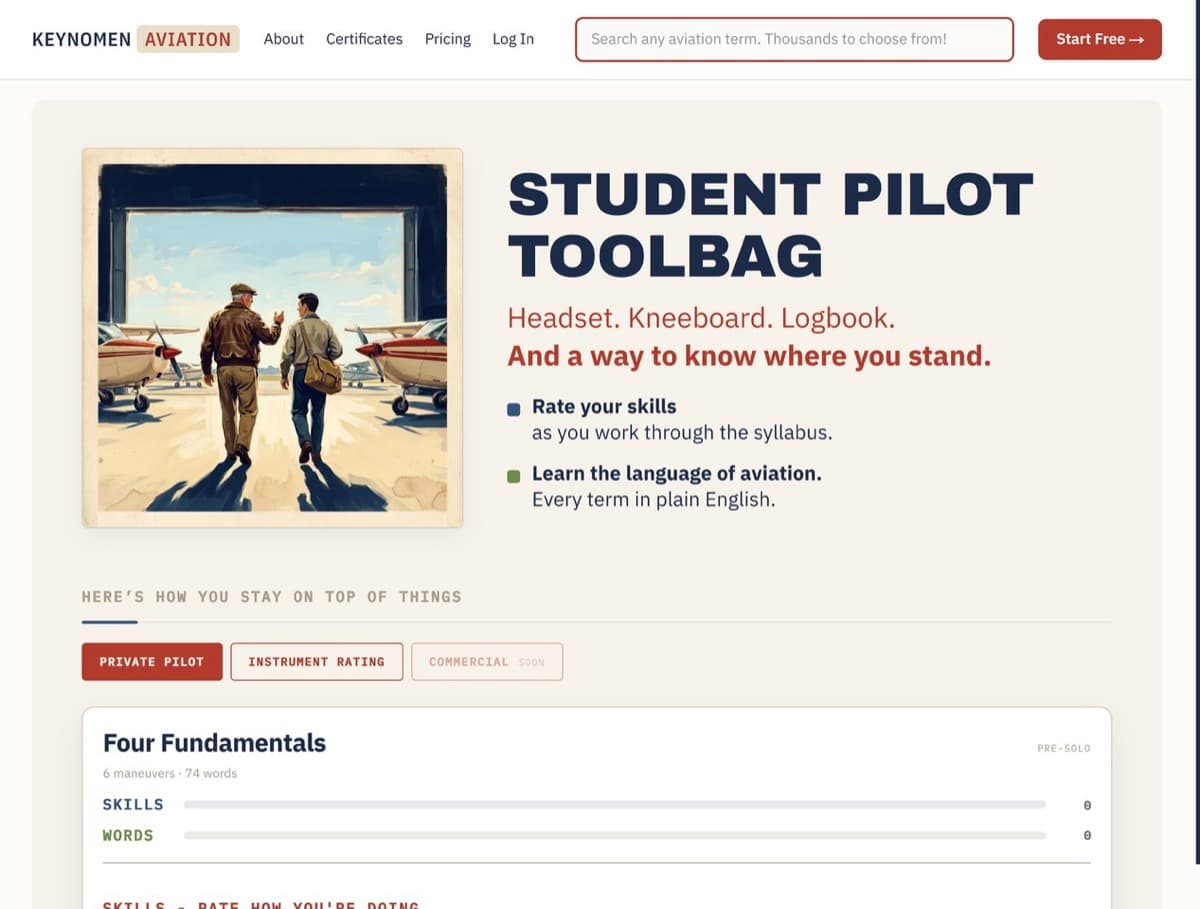
Under the heading of Four Fundamentals, (where 74 new terms live) the user might select “yaw control” as unfamiliar. Clicking on that expression leads to a page that includes a paragraph describing the plain English meaning. That’s just the start of the resource, however. Additional information follows, including a context anchor, the derivation of the term, an explanation of why pilots would care, as well as example sentences with the term being used in day-to-day practice.
Keynomen shifts the student from struggling to simply memorize the definition of new and unusual terms to a state where they can truly understand them on a far deeper level. Each study session improves their grasp, as well as their ability to use the new term effectively.
Keynomen’s database includes 25,000 terms. Each one was checked and double checked before Bezden personally edited and approved their inclusion into the finished product.
There is no doubt Keynomen has value to any new aeronautical aspirant seeking any certification or rating. The language of aviation is a mystery to most, while a clear understanding of that language is essential to the safety and security of those who work or recreate in the industry.
And speaking of language, English is the international language of aviation. In every nation on the planet, English is used to communicate between professionals and amateurs in flight and on the ground. If a native English speaker can benefit from developing a deeper understanding of the terms used in the industry, imagine the benefit to those who speak English as a second language.
Some may agree with Bezden that the enigma of aeronautical English is a measurable factor in the reason so many flight students drop out. Some may take a less charitable view. It is undeniable, however, that terminology and a clear understanding of the language pilots speak has a profound effect on the safe outcome of each and every flight we undertake.
Keynomen is a step in the right direction: A learning tool specifically created to solve an existing problem. One that presents a limitation or a hurdle each and every one of us will confront at one time or another. Perhaps this educational resource will chip away at that drop-out rate, making access to the cockpit just a tad less challenging for new and experienced pilots alike.
Keynomen is free to try, which allows you to access 100 terms. A Pro Account, which gives you access to all features, is $149 a year.
For more information: Keynomen.com

Leave a Reply