

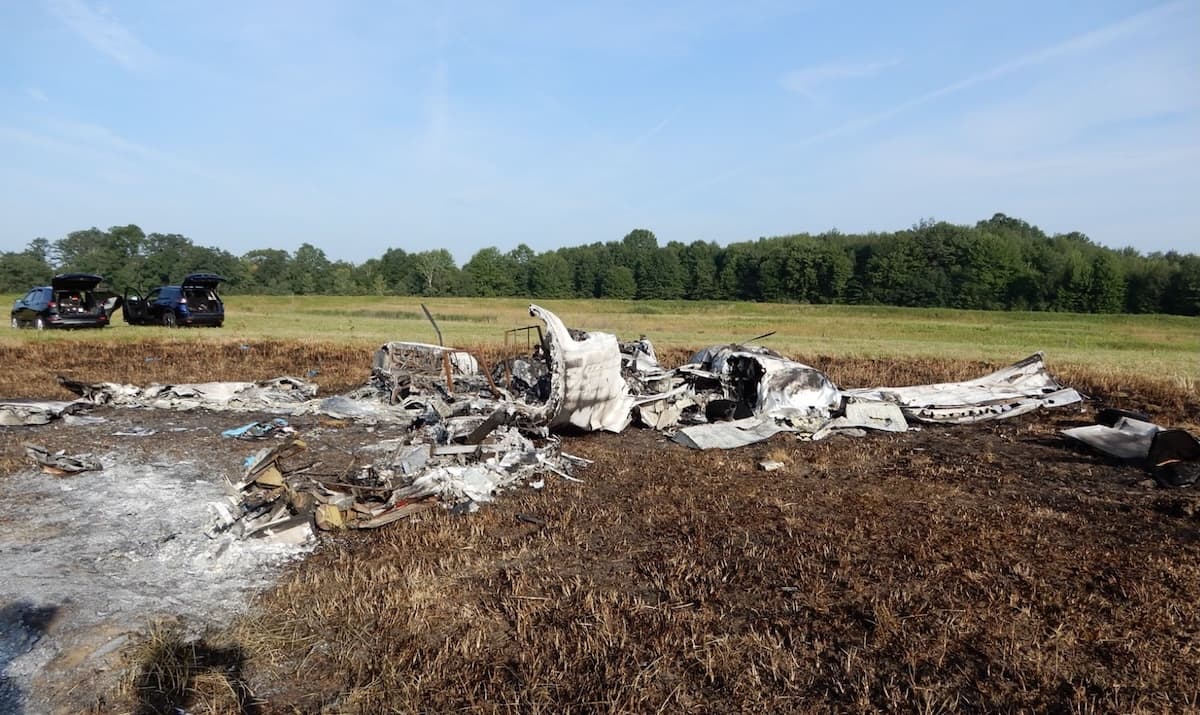
The pilot purchased the Beech B-60 on Sept. 1, 2023, four days after the most recent annual inspection.
The last maintenance was recorded on July 17, 2024, two days before the accident.
The service included application of sealer to the left and right wing deice boots near the fuel filler caps, and an oil and filter change on both engines. The mechanic who changed the oil reported that it was “black and nasty” when he first changed it, and the filter was installed more than two years before. He changed the oil two more times before it finally cleared up and he signed off the maintenance in the logbooks.
An examination of the engine logbook entries for the 2023 annual inspection showed no entry for oil or filter changes for either engine.
A personal acquaintance of the pilot, who was familiar with the airplane, reported that the pilot asked him to fly the airplane, but he refused, citing airworthiness issues. He added that the airplane was parked outside in Plattsburgh, New York, for months without moving, and in the winter it was covered in snow. The airworthiness issues that he was aware of included damage from a hard landing, water in the fuel tanks, hydraulic issues (no fluid in the reservoir), and dry rot of the tires.
He told investigators that the pilot reported problems with the left engine backfiring. He also stated that the pilot seemed to be in a rush to get the airplane flying again, and he warned the pilot to address these issues before the pilot flew it.
On July 19, 2024, ADS-B track data revealed that the flight departed Runway 17 at Plattsburgh International Airport (KPBG) in New York, destined for John Glenn Columbus International Airport (KCMH) in Columbus, Ohio. After departure, the Beech B-60 proceeded to the southwest and climbed to 16,500 feet.
When the plane was about 75 miles northeast of Youngstown/Warren Regional Airport (KYNG) in Vienna Center, Ohio, the pilot told air traffic control that he was experiencing a problem with the airplane and requested a deviation to KYNG. The controller offered information on a closer airport, however the pilot requested KYNG and its longer, 9,003-foot runway. A few minutes later he told the controller the left engine was “dead.”
The airplane proceeded to KYNG from the south and arrived overhead the approach end of Runway 32 at 3,200 feet mean sea level, or about 2,000 feet above ground level, at 114 knots ground speed. While descending, the airplane twice circled to the left near the approach end of Runway 32, eventually lining up on final approach over the approach end of the runway, about 500 feet AGL at 123 knots ground speed. The airplane then proceeded down the centerline of Runway 32 while continuing to descend.
About 3,500 feet from the departure end of the runway, ADS-B data indicated that the airplane was close to the airport elevation at a ground speed of 131 kts. At the end of the runway, the ground speed slowed to 95 kts. Airport surveillance video showed the airplane pitch up and to the left at the departure end of the runway. It continued into a left, descending turn until it hit terrain about ¼ mile west of the departure end of the runway. The pilot and two passengers died in the crash.
A witness on KYNG Taxiway D observed the airplane in flight before the accident. He told investigators that the airplane circled near the approach end of Runway 32, then proceeded with the approach down the runway. The plane was higher than normal when beginning the approach. As it proceeded down the runway, it descended, however it did not touch down. At the end of the runway, it pitched up rapidly to the left and began to “flip.” The airplane then descended below his field of view.
The wreckage was located on airport property, outside the perimeter fence. A post-accident fire consumed a majority of the wreckage.
All structural components of the airplane were found within the wreckage debris path.
All three landing gear actuators were found in the extended (down) positions. The landing gear selector was in the extended position. The left and right wing flap actuators were found in the fully extended positions. The rudder trim actuator was found near the neutral position.
All primary flight control surfaces (ailerons, elevator, and rudder), with their appropriate trim tabs and flaps, were accounted for at the wreckage site. Continuity of all primary flight control cables was confirmed from the cockpit to their respective flight control surfaces.
The wing fuel tanks were destroyed by the fire. The left and right fuel selector valves consisted of three positions: Off, Main, and Crossfeed. Both valves were found in the Main tank position.
The engines were examined after recovery of the wreckage to a salvage facility.
There was evidence of detonation damage in both engines, as well as contamination of the fuel inlet screen with a sand-like substance.

The sand-like debris that was found in the left and right engine fuel servos was sent to the NTSB Materials Laboratory for analysis. A spectral library search was performed, which found a strong match for PET, a thermoplastic polymer of the polyester family that is commonly found in fuel system components.
Probable Cause: The pilot’s loss of airplane control during a single-engine go-around. Also contributing to the accident was fuel system contamination, which resulted in detonation and a total loss of left engine power.
To download the final report. Click here. This will trigger a PDF download to your device.
This July 2024 accident report is provided by the National Transportation Safety Board. Published as an educational tool, it is intended to help pilots learn from the misfortunes of others.
Cheap is always very expensive at some point. Being in a hurry never saves time. Mankind never learns….