

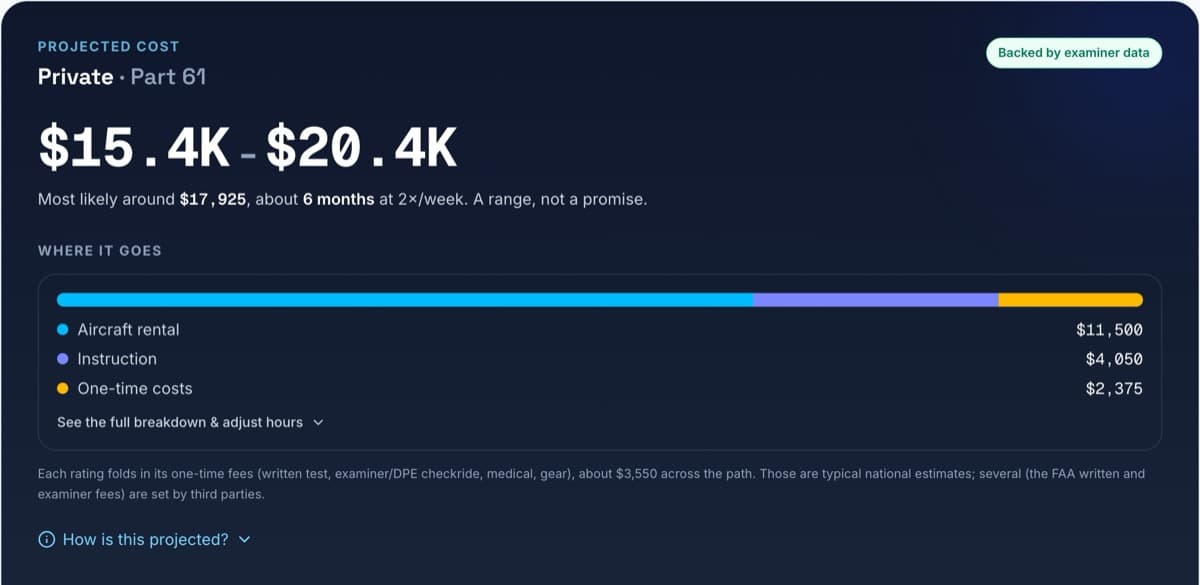
PilotBound, a free cost-planning tool for student pilots, projects what a pilot certificate will actually cost using FAA examiner completion data rather than the 40-hour FAA minimum most quotes are built on, according to Samip Shah, the CFI, CFII, and AGI who built it.
Completion data compiled by Designated Pilot ExaminerJason Blair puts the typical Part 61 private pilot closer to 72 hours at the checkride. Because rental and instruction are roughly 80% of the bill, those hours account for most of the gap between a quote and the final invoice, according to Shah.
Shah’s 2026 Flight Training Cost Report puts a private pilot certificate at about $17,925 at median published rates over a 72-hour completion, using a sample of schools that publish their rates rather than a national average.
“Nobody hands a student the real number,” Shah said. “I borrowed about $90,000 for my own training and paid roughly $222,000 by the time the balance hit zero.”
PilotBound returns a cost range in about 30 seconds based on a student’s own rates, region, and planned flying frequency. It features a 16-step plan from discovery flight to checkride. There’s also a free iPhone app that tracks real spending against the projection, flagging the month a budget is projected to run out.
The site also publishes free directories of:
- 250 flight schools across 48 states, each with the school’s own published rates and a verification date
- 60 accelerated academies and 37 collegiate aviation degree programs
- 62 aviation scholarships carrying at least $438,200 in combined top awards
For more information: PilotBound.app
Learn to fly in an older 150 based at a grass strip, and an older CFI who does it for the enjoyment – you can do it for a LOT less that way.
Learn to fly in a brand new 172/Cirrus/etc. at a fancy FBO with carpets on the floor, with CFIs who wear uniforms and really want to build hours so they can get airline jobs – this is going to cost you. (I think the expression is “bigly”.)
The certificate is the same either way . . .
Ouch