

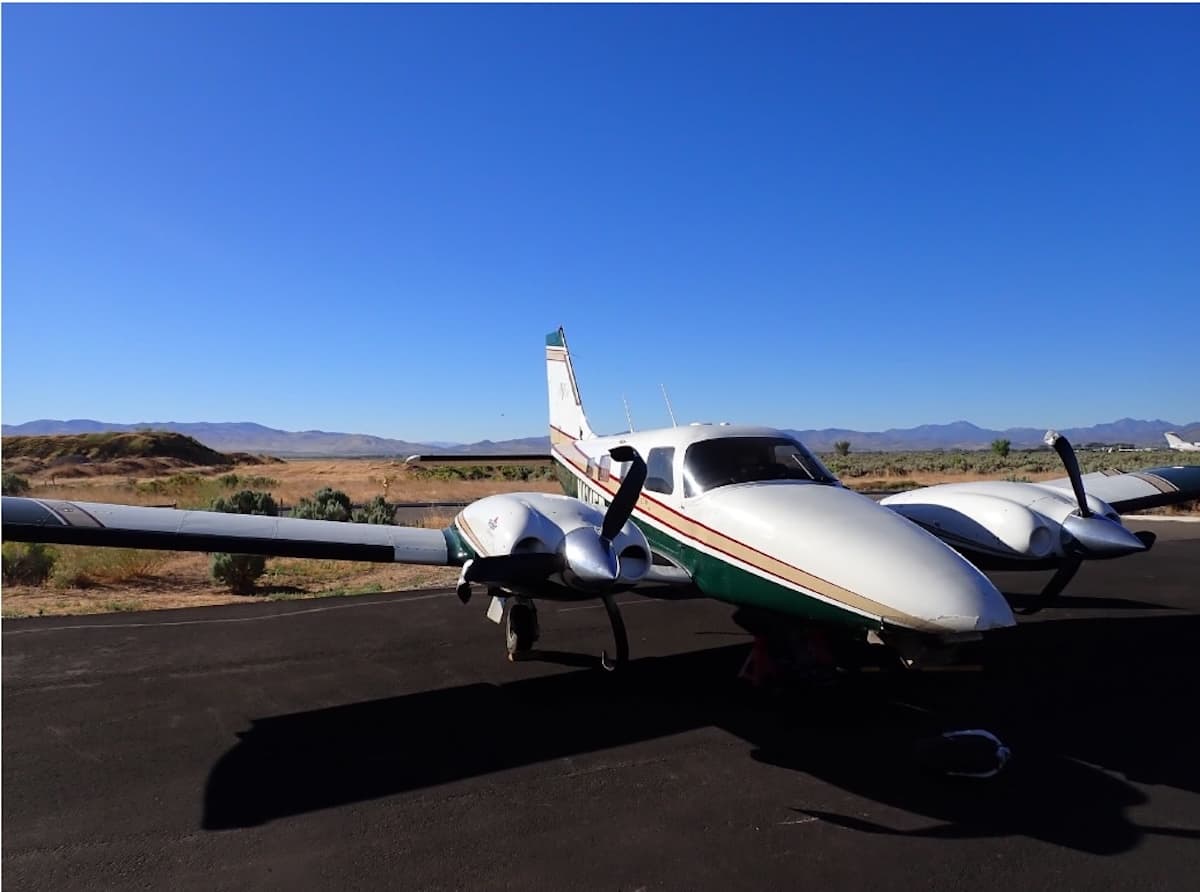
The pilot told investigators that the purpose of the flight was to conduct a maintenance check flight following an annual inspection of the Piper Seneca.
During the preflight inspection, he conducted a functional check of the stabilator trim with the electric trim control. He heard the trim motor working, however he did not visually verify the stabilator trim position.
During the takeoff roll from the airport in Minden, Nevada, he pulled back on the yoke at the rotation speed of 80 knots, but there was no change in pitch, so he pulled harder. He used the electric trim and had minimal elevation gain. He aborted the takeoff by closing both throttles. The airplane pitched forward, porpoised about four times, and the landing gear collapsed.
Post-accident examination of the airplane revealed buckling and bending on the forward fuselage near left and right wing. Buckling and bending was also observed above the windscreen on the fuselage. The stabilator trim wheel indicator was found in the full nose-down position.
The airplane’s pilot operating handbook preflight checklist states: “Stabilator & Rudder trim…. Neutral.”
Subsequent examination of the stabilator trim wheel revealed binding. Force was needed to rotate the stabilator trim control wheel to the neutral position when rotated by hand.
Using the airplane’s battery, power was applied to the electric trim controls. When the stabilator trim was placed in the full nose-down position, the electric trim servo was heard operating, but would not move the stabilator trim cable.
A visual examination of the stabilator trim control cable was conducted. No damage was observed.
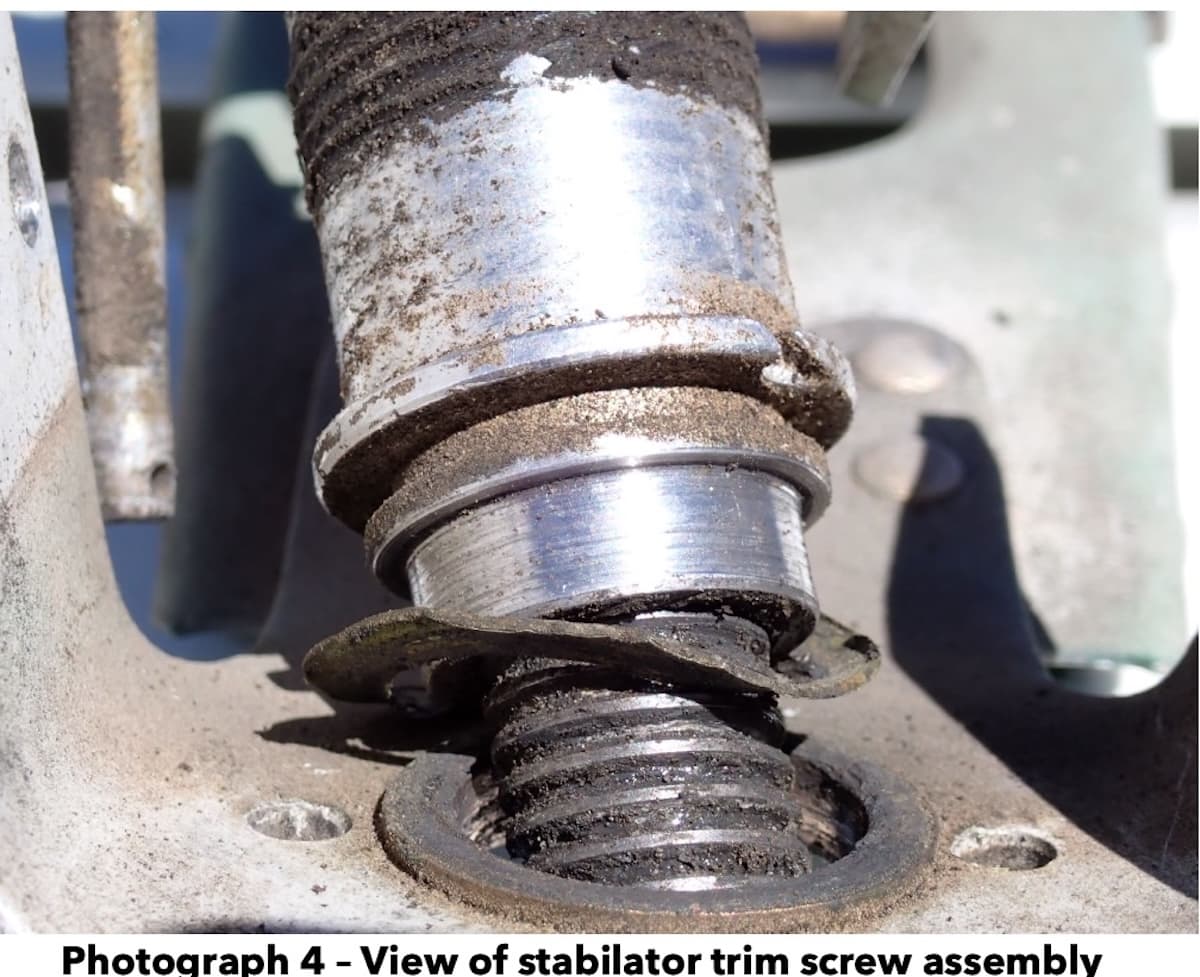
The empennage flight control cover was removed, and a visual inspection of the trim screw assembly was conducted. Corrosion was observed on the trim screw assembly. The exposed shaft of the trim screw was free of lubrication. The ends exhibited minimal lubrication. The trim screw assembly had radial and axial play when moved by hand, consistent with excessive wear on the upper-and lower-barrel mount bearings. The trim screw assembly was disassembled, and circular grooves were observed on the outer sections of the upper-and lower-barrel mount bearings.
According to the mechanic who conducted the annual inspection, no anomalies were noted with the flight controls or the stabilator trim controls. The mechanic’s normal process to check and lubricate the stabilator trim controls was to run the stabilator trim to the full nose-up position, lubricate the stabilator trim shaft, and then run the stabilator trim to the full nose-down position. During the exam of the stabilator trim shaft, he operated the stabilator trim controls and his apprentice lubricated the stabilator trim shaft.
The apprentice did not recall lubricating the stabilator trim controls. Additionally, he did not conduct a functional check of the stabilator trim controls.
According to the manufacturer’s maintenance manual checklist, the scheduled maintenance of the fuselage and empennage group stated, “Inspect aileron, rudder, stabilator, and stabilator trim cables and pulleys for routing, safety, condition, and operation. Inspect cable terminals, turnbuckles, guides, and fittings for safety and condition.”
The lubrication chart in the maintenance manual also identified that the rudder, stabilator, and trim control wheels be lubricated every 100 hours.
Probable Cause: The pilot’s improper preflight inspection of the stabilator trim position, which resulted in a porpoised landing. Contributing to the accident was the maintenance personnel’s improper maintenance of the stabilator trim shaft.
To download the final report. Click here. This will trigger a PDF download to your device.
This August 2024 accident report is provided by the National Transportation Safety Board. Published as an educational tool, it is intended to help pilots learn from the misfortunes of others.
History repeats itself once again…similar (lack of/improper maintenance) circumstances of how the lack screw failed on a stabilizer control surface. Anyone remember the Alaska Airline’s B727 that crashed off the Ventura California coast? Due to lack of proper lubrication it’s Jack screw also failed causing it to crash into the Pacific, killing all aboard. Sad how such a simple item of maintenance can be so consequential.
I remember the AK 737 crash here.
I do lube the elevator jackscrew on my old Cessna at every annual.
It’s not easy …remove the access cover on the underside of the right stab., run the trim full down to expose most of the screw, add the correct grease, run the trim to full up and down to lube the fixed nut.
Then remember to lube the chain that drives the jack screw….and all the pulleys to the trim wheel, [lube it too].
This is a good lesson for any preflight. The movement of the ailerons is easy to check visually from the cockpit. But the surfaces on the empennage (elevator, rudder, pitch trim, rudder trim) can’t be seen from the cockpit unless it’s a Cessna, and require multiple trips from the cockpit to the rear of the airplane to check full movement of each surface in both directions. And to verify correct position of each surface when the cockpit control is in the neutral position. But I can’t think of anything much worse than not having normal control of the airplane.
I think that a better title would be ‘ Lack of Lubrication of the Stabilator Trim….
So, what else did these A&Ps not do ?
Did’t the pilot ever use the manual trim and note that it was stiff ?