

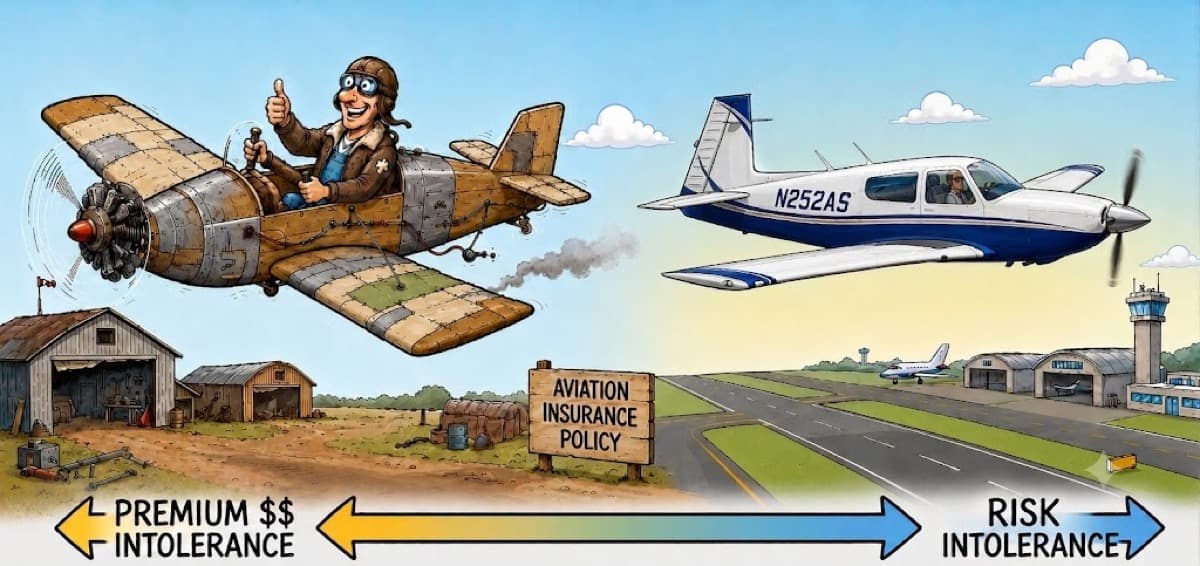
If you want to see an aircraft owner undergo a dramatic physiological transformation, don’t subject them to a barrel roll — just show them their annual aviation insurance renewal premium.
In my professional practice, I witness it regularly. A pilot opens their insurance policy declaration page, looks at the premium, and instantly experiences a spike in blood pressure. This reaction is what we can call “Premium Intolerance.”
However, there is an equal and opposite force balancing the scale on the other side of the ledger: “Risk Intolerance.”
Every insurance policy is a structured, ongoing negotiation between these two positions, and buyers generally find themselves psychologically being pulled toward one of two extremes.
On the left, a buyer blinded by Premium Intolerance strips their coverage down to the absolute bare minimum to save a dollar, only to complain bitterly when a loss occurs and they realize they bought a sieve instead of a shield.
On the right, a highly risk-intolerant buyer will gladly pay extra premium for top-tier coverage, yet they end up equally frustrated when they discover that even a gold-plated policy has legal boundaries and doesn’t cover everything.
Neither extreme represents a perfect outcome because both miss the fundamental reality of the transaction.
In previous articles, we broke the insurance transaction down into three phases: The Front End (Underwriting), the Body (The Contract), and the Tail (The Claims) (“Don’t Do Anything Stupid“), then took a close look at the front end using the underwriting compass (“Telling the Story of Risk“).
Now, we open up the black box of the body, which is the actual insurance contract itself.
A Legally Binding Contract
The most critical concept an aircraft owner can grasp is that an insurance policy is not a receipt for a financial transaction. It is a legally binding contract of mutual obligations. The insurance company agrees to assume specific financial risks, but only in exchange for your absolute compliance with a series of operational boundaries. If you breach your side of the agreement, you are no longer flying an insured aircraft. You are operating entirely on your own asset sheet.
To truly understand the language of a policy, you must look at who the contract is actually designed to pay.
An aviation insurance policy is essentially two entirely different legal agreements housed in a single document, distinguished by the payee.
First is the hull coverage, where you are the payee. If you damage your aircraft, the carrier cuts the check to you or your lienholder to repair or replace your asset. In this quadrant, you retain a high degree of control. You control the maintenance, the hull value you choose to insure, and ultimately, how you manage the physical recovery of the aircraft.
Second is the liability coverage, where the injured party is the payee. If something you do causes bodily injury or property damage, the check goes to a third party, such as a passenger, a bystander, or the owner of a hangar you just taxied into. Here, you have absolutely zero control over the outcome. You cannot control the medical inflation costs of an injured passenger, the legal fees of an aggressive plaintiff’s attorney, or the value of a destroyed corporate twin on the ramp next to you.
When buyers shop for insurance, they naturally focus on the headline numbers like the hull value and the total liability limit. Seeing $1 million of liability brings a false sense of security, because how that liability limit is structured determines how much protection you actually have when control is stripped from your hands.
Aviation insurance typically structures third-party liability in one of two ways.
In the first, a policy may offer sub-limits, which means you have a total limit, but also a restrictive clause stating something like $100,000 per passenger seat or, in some cases, a per-person restriction not exclusive to passengers.
In the event of a runway excursion where passengers suffer injuries, the policy’s coverage is strictly capped at that lower threshold. In a modern medical and legal environment, $100,000 can be exhausted before the ambulance leaves the airport, leaving your personal or corporate assets entirely exposed for any excess damages.
Conversely, the second way is known as a smooth limit, or Combined Single Limit, which removes the per-seat restriction. A smooth policy deploys the full million-dollar shield wherever it is legally or practically required most, whether that means treating a seriously injured passenger, covering third-party bodily injury, or repairing severe property damage.
Underwriters utilize sub-limits as a tool to manage their risk intolerance. Because they know you lose control over a liability outcome, they install these internal guardrails to cap their own exposure.
To move across the spectrum toward smooth limits, an insured must demonstrate an operational profile that convinces the underwriter to remove them.
A Hidden Protection
Fortunately, there is a hidden reservoir of protection within the policy that benefits both sides of the spectrum through ancillary expenses borne by the carrier that often carry no stated dollar limits. These are critical operational lines that do not erode your liability or hull limits.
Aircraft recovery is a prime example. If an aircraft ends up off the runway, in a marsh, or blocked by terrain, the physical cost of crane rentals, flatbeds, and environmental mitigation can easily skyrocket into tens of thousands of dollars. The contract typically provides that the carrier handles the extraction and recovery to a safe location for adjustment, independent of your hull value.
Legal defense costs are equally vital. If you are sued following an incident, the insurance carrier doesn’t just hand over a check for the policy limit and wish you luck. It is contractually obligated to provide, manage, and pay for your legal defense. In a complex aviation lawsuit, specialized defense attorneys can bill through a $100,000 retainer in the first few weeks of discovery. Because these defense costs are usually paid in addition to the policy limits, your liability shield remains fully intact to pay actual claims or settlements rather than being eaten alive by billable hours.
These uncapped provisions are where the carrier’s risk intolerance truly goes to work on your behalf. They pour resources into recovery and defense because they are protecting their own balance sheet just as much as yours.
A Pilot’s Part of the Bargain
Because the insurance company puts so much capital and logistical support on the line, the contract explicitly defines who is allowed to command that risk. This is where the pilot warranty comes into play.
Pilots are inherently collaborative and often share the keys to their aircraft so a colleague can maintain currency. Before doing so, an owner might vaguely recall their broker mentioning an open pilot clause and assume the flight is covered.
This is where strict adherence to the contract is vital. The open pilot warranty is not a blanket authorization for anyone holding a pilot certificate. It is a highly specific, conditional legal covenant.
For instance, an open pilot warranty might state that an un-named pilot may operate the aircraft provided they possess 1,000 total logged hours, 200 hours in retractable-gear aircraft, and 25 hours in your specific make and model. If a pilot with 950 hours operates the aircraft and has an incident, the carrier is under no contractual obligation to honor the claim.
In the insurance environment, underwriters do not evaluate “close enough.” If the pilot flying does not exactly match the precise metrics of the open pilot clause at the moment of engine start, the operational chain is broken.
Warranties
In consumer markets, a warranty is a promise made by a manufacturer to repair a defective product. In an insurance contract, the definition is reversed. An insurance warranty is a strict, legally binding promise made by you to the insurance company. By accepting the policy, you warrant that you will maintain specific operational standards. If you breach a warranty, the contract can be rendered void.
Primary examples include the airworthiness warranty, which is a commitment that the aircraft will be maintained in a legal, airworthy condition. Flying past an annual inspection or failing to comply with a mandatory Airworthiness Directive means violating the core terms of the contract. There is also the medical or BasicMed warranty, which is a commitment that the pilot in command will maintain the appropriate medical qualifications required for the specific operation.
The further an operation moves toward the risk-intolerant side of the scale — utilizing high-performance twins, experimental platforms, or specialized operating territories — the more rigorous and precise these contract warranties become to balance the carrier’s exposure.
We routinely invest significant resources into advanced avionics, meticulous pre-flight inspections, and recurrent training to mitigate physical risks in the air. Yet, it remains an industry paradox that many aircraft owners treat their insurance policy like a standard software end-user agreement, scrolling to the bottom, accepting the terms, and filing it away unread.
Compounding this mistake is the fact that aviation insurance carriers do not use standardized forms. They issue entirely unique contracts filled with their own specialized wording, conditions, and definitions. Moving your coverage from one carrier to another isn’t a simple apples-to-apples transition. In terms of personality and rules, changing insurance companies can be as wildly different as dealing with your son versus your daughter.
Don’t do anything stupid on the front end by ignoring the fine print. Your policy isn’t a receipt for a financial transaction. It is a restrictive and legal flight plan. Take 20 minutes this week to thoroughly read the body of your policy. Know your pilot requirements, understand your precise liability limits, and ensure that you are actively flying the contract you paid for. Otherwise, Murphy is just waiting for his turn at the controls.

Leave a Reply