

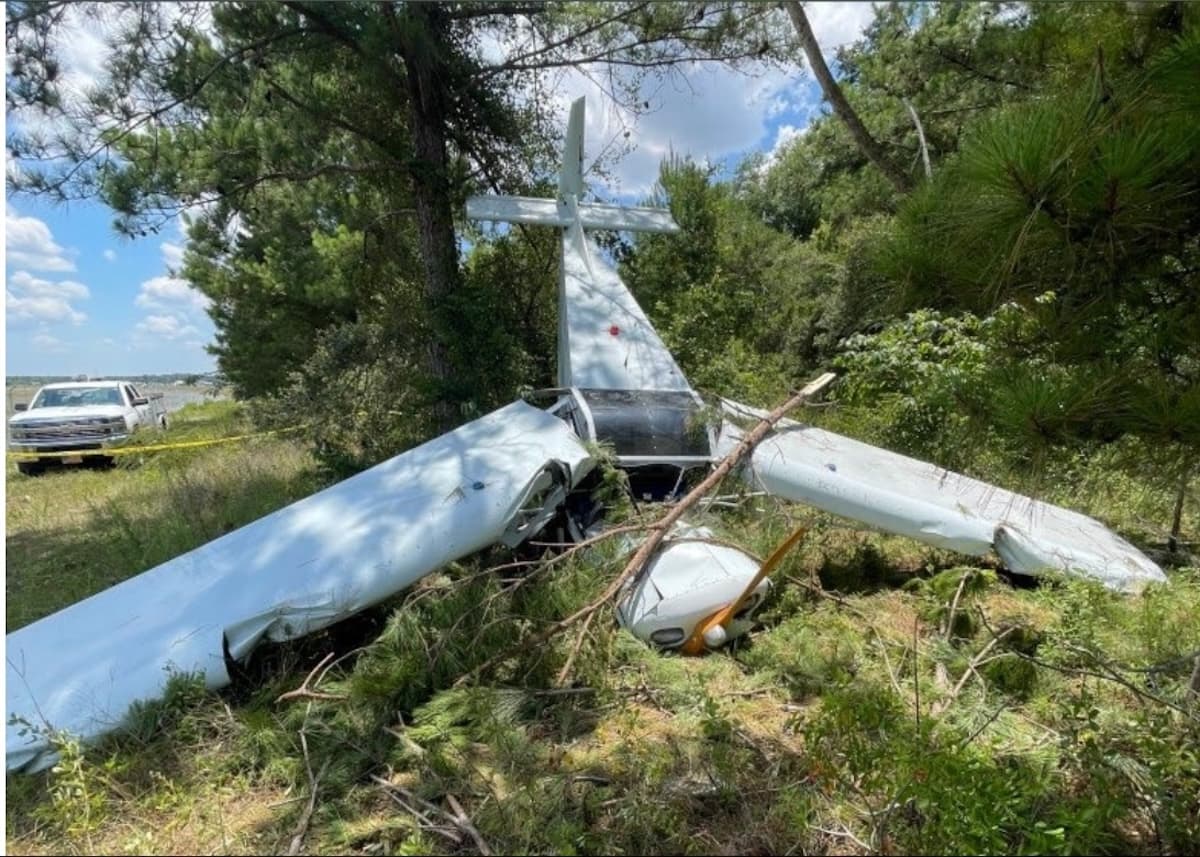
The Zenith 701 was on short final approach to Runway 36, a 7,467-foot-long runway at Ocala International Airport (KOCF) in Florida. The pilot told investigators he encountered a large number of birds and elected to perform a go-around to the left of the runway, however, the airplane “did not climb as expected” and collided with trees near the end of the runway.
The pilot did not say whether he utilized carburetor heat during the landing approach or after initiating the go-around.
During an interview with an FAA inspector, an air traffic controller on duty at the time of the accident said the airplane departed about 1930 and the pilot stated that he would be “doing pattern work.” The pilot completed two orbits, but did not perform any touch-and-go landings.
After completing two low approaches, the airplane was cleared to land on Runway 36 and turned onto the base leg of the airport traffic pattern. On final approach, at an altitude about 20 feet above the runway, the airplane turned abruptly 45° to the west and appeared out of control. The airplane began to climb and then turned “hard left and nose-dived” into the trees. The controller did not mention birds during his interview.
Airport security video captured the airplane on short final approach. Due to automatic panning, the video did not capture the accident sequence, but no birds were observed when the airplane was on short final approach.
During an interview with an FAA inspector, the airplane owner said the pilot was attempting to build flight experience to meet the requirements of an airline transport pilot certificate. He worked for the owner part-time and asked if he could fly the airplane. The owner agreed, but required the pilot to fly with a flight instructor due to his lack of experience in the airplane make and model. The pilot did not follow the owner’s instructions and was flying solo at the time of the accident.
The pilot reported a total flight experience of 490 hours, of which one hour was in the accident airplane make and model.
The FAA inspector observed the wreckage nose-down in a wooded area. Both wings were bent forward and sustained damaged to their leading edges. The fuselage also sustained substantial damage. The commercial pilot sustained minor injuries in the crash.
The wreckage was transported to a recovery facility, where an independent mechanic started the engine and conducted a test run to full power.
The reported wind at OCF at 1951 was from 250° at 8 knots. The reported temperature was 31°C and the dew point was 24°C. The calculated relative humidity at this temperature and dewpoint was 66%. Review of the icing probability chart contained within FAA Special Airworthiness Information Bulletin CE-09-35 revealed the atmospheric conditions at the time of the accident were conducive to icing at “glide (idle) and cruise power.”
Probable Cause: The pilot’s failure to maintain aircraft control and his exceedance of the airplane’s critical angle of attack, which resulted in an aerodynamic stall and spin during an attempted go-around.
To download the final report. Click here. This will trigger a PDF download to your device.
This June 2024 accident report is provided by the National Transportation Safety Board. Published as an educational tool, it is intended to help pilots learn from the misfortunes of others.
Once again, ineptitude of the PIC displays the the three phases of flight we all try to avoid…”stall, spin and crash”!
Good thing he wasn’t severely injured/killed.
Good show. Arrogance proves expensive once again.