

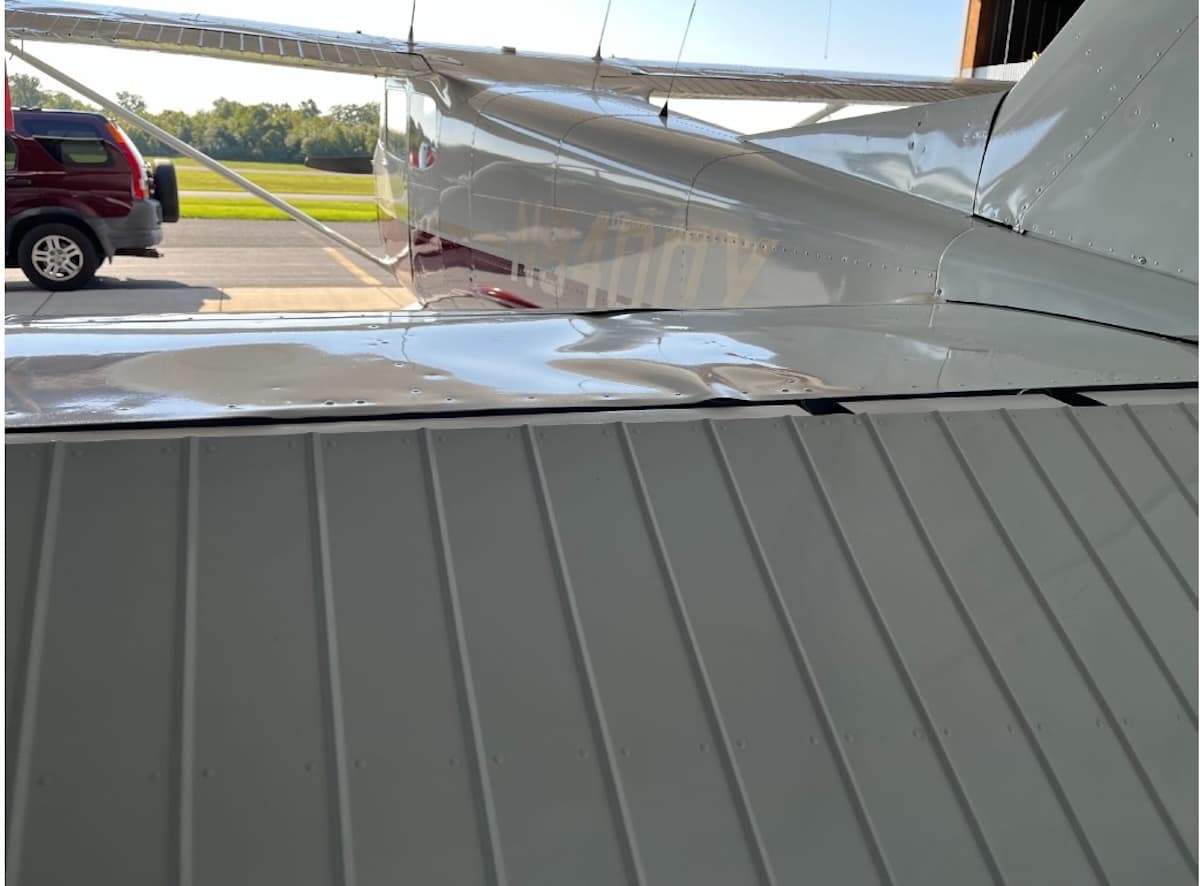
The pilot completed two successful takeoffs and landings in the traffic pattern at the airport in Elkwood, Virginia, and was taking off for a third time when the accident occurred.
After he applied takeoff power, the Cessna 172 accelerated forward for less than 75 feet when the pilot’s seat slid back to the aftmost position.
The pilot let go of the control yoke to prevent the airplane from pitching upward, but as the airplane continued to accelerate, he was unable to reach the rudder pedals and brakes.
He was eventually able to reach the throttle and reduced it to the idle position.
The airplane departed the left side of the runway and came to rest in a ditch, resulting in substantial damage to the horizontal stabilizer and elevator.
Post-accident examination of the airplane revealed that the pilot’s seat was not correctly installed and that the front left seat rail guide was not engaged with the rail. This resulted in the seat being positioned too high and prevented complete engagement of the seat adjustment rod.
When the seat was adjusted, its position would lock, but when sufficient aft force was applied to the back of the seat, the adjustment rod would disengage and allow the seat to move.
The pilot told investigators that he removed and reinstalled the seat to perform preventative maintenance.
Probable Cause: The pilot’s failure to correctly reinstall the airplane’s left seat, resulting in the movement of the seat during the takeoff roll, and the subsequent loss of control and runway excursion.
To download the final report. Click here. This will trigger a PDF download to your device.
This August 2024 accident report is provided by the National Transportation Safety Board. Published as an educational tool, it is intended to help pilots learn from the misfortunes of others.
How can this still be a problem??
The FBO I worked for had a 172 that was rented to the FAA and was the cause of the revision to the Cessna seat rail AD revision. We had the secondary seat stop kit from Cessna installed and it would not release to move the seat back and the FAA pilot exerted enough force that it broke the seat rails out and the seat slid back beyond where the pilot seat was properly positioned. The primary seat stop kept it from sliding all the way back. I took a call from the FAA Regional manager who was upset over this happening and wanted us to get this aircraft off their ramp. We retrieved the aircraft and inspected it for what had happened and inspected it in accordance with the current AD and determined that the seat rail was in compliance with the AD! Inspecting the seat further revealed that the seat pawls were worn and spread out and when it had hard force it broke out of the seat rails. Called up our FAA PMI and had them come visit us to show them what had happened. They took this information down and help work on the revision for the seat rail inspection to include the inspection of seat pawls, rollers, etc.
Cessna came out with a kit to prevent a seat from sliding back if the pilot does not get the seat locked properly. It is an inertial lock with a strap that is attached to the floor of the plane and to the seat. When you lift the handle to adjust your seat, it releases when you release the handle to engage the pin in the seat rail it locks. If the pin does not go into one of the holes in the seat rail your seat is still locked and can’t move. I installed one on my Cessna 180 and I paid for the kit, but after the mechanic installed it and signed off on it, Cessna reimbursed me for the cost.
Seat Locks are sold at Aircraft Spruce for about 80 bucks. Quick solution to a long standing problem.
Saf-T-Stop – Pair https://cdn.aircraftspruce.com/catalog/graphics/3/13-18510.jpg
This has been a long standing problem dating back to the 1970’s when I first start my flight training to become a pilot. At Kupper Airport in New Jersey. Now Central Jersey Airport 47N. While training this would happen but we use clamps on the seats to lock seat in place.
Common issue on 150s also. The lock pin is tapered and if there is any wear on the holes in the seat track, it can slip out and the seat goes all the way back. Fortunately, “all the way back” isn’t very far in a 150, but it is VERY disconcerting. Reflex is to grab something, that something is usually the yoke (your hand is already there) and practicing stalls 25 feet AGL is not a wonderful idea. There’s an AD note and some specs on how worn the holes in the rail can be, but I would strongly advise one of the safety stopper devices anyway. Think also about replacing the seat rollers, they are often worn and always grubby. Make sure the carpet doesn’t interfere with anything either. Another thing to check is wear on the tangs on the seat frame that go under the seat rail. These have been known to wear and while I have seen replacement parts for 172, I have not seen them for 150s. You want as little slop and “wiggle” as possible in this area.
Besides checking the seat lock pin before flight. When the seats are removed for the annual inspection, there are specs on the pin extension and shape of the tip…square, not rounded.
There are specs on the seat retainer ‘U’ parts, gap between the 2, and shape.
I’ve also replaced the 4 seat rollers , after 65 years, they were worn and sloppy on the bolt.
All this is done under the guidance of an A&P IA.
I’ve done this a couple of times, but look to be sure that the roller is in the track. It is difficult to get the left front roller in the track, since the corner of the seat hits the side wall panel, requiring a lot of forcing, [ and some nasty words ]
If the opening in the seat track was 3/4 inch back it would be much easier.
Also, having only one pin to lock into the track can be a problem if the track wears. Having a second pin, maybe on the right side or a rear roller would be a lot safer.
I have a secondary seat stop in the left rear track to not allow the seat to slide past where I can reach the controls. But it makes getting in and out of the seat a bit more tough, especially of my ‘older’ body.!!
Probable cause: the pilot neglected to use nasty words when re-installing the seat.
It seems to help with all the pushing and shoving…!!
Just curious, this has never happened to me, but I think about it on my checklist. Could or did the pilot unfasten their seatbelt and try to scoot up to the controls to abort. Just asking.
I check this every flight. is seat locked in? Yep.
Rookie mistake. Anybody who flies a 172 knows to check their seat is secure before takeoff. It becomes second nature. I check it an average of five times before I get to the runway. C’mon!
I believe seat rails are not on Part 43
It is part of the Cessna 100 hour inspection checklist, that it commonly used for annual inspections.
Airframe, item #5.